

Temporary exhibitions
The studio space of the Finnish Museum of Games is reserved for small temporary exhibitions. Among other things, these exhibitions will bring forth interesting phenomenons and products of the gaming world, as well as the history and people around them.
Past exhibitions
-
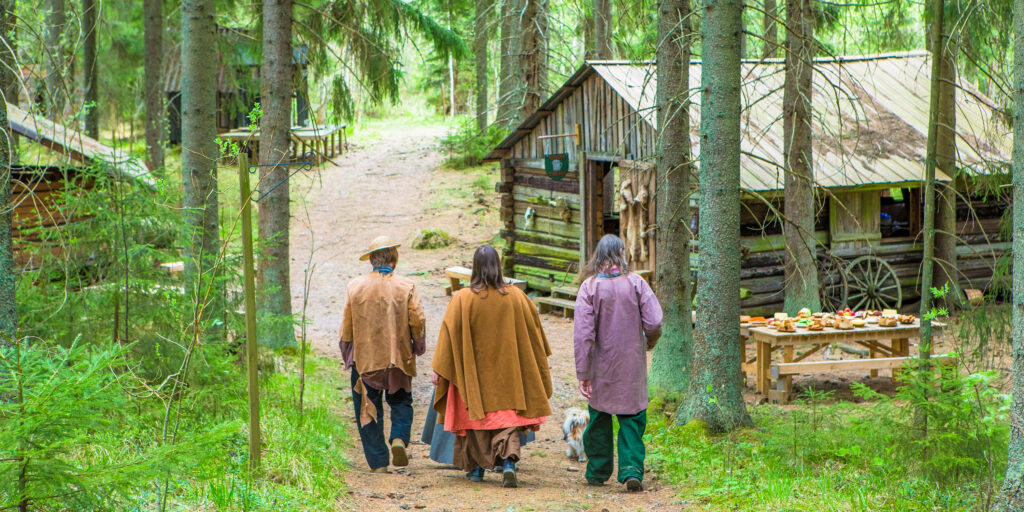
The exhibition features an extensive selection of photographs from Rajakatse’s LARP events over the decades.
-
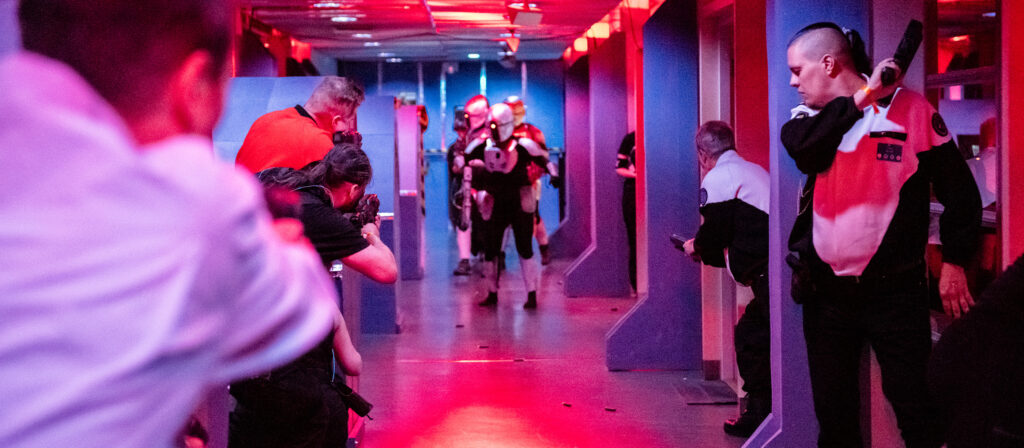
The exhibition Odysseus – The Story of a LARP, created in collaboration between the Odysseus team and the Finnish Museum of Games, dives into the story of Odysseus and how the game was built. Photos, videos, objects and stories take the visitors to the world of Odysseus, offering a peek behind the scenes of the game project.
-
23.5.2025 – 1.3.2026
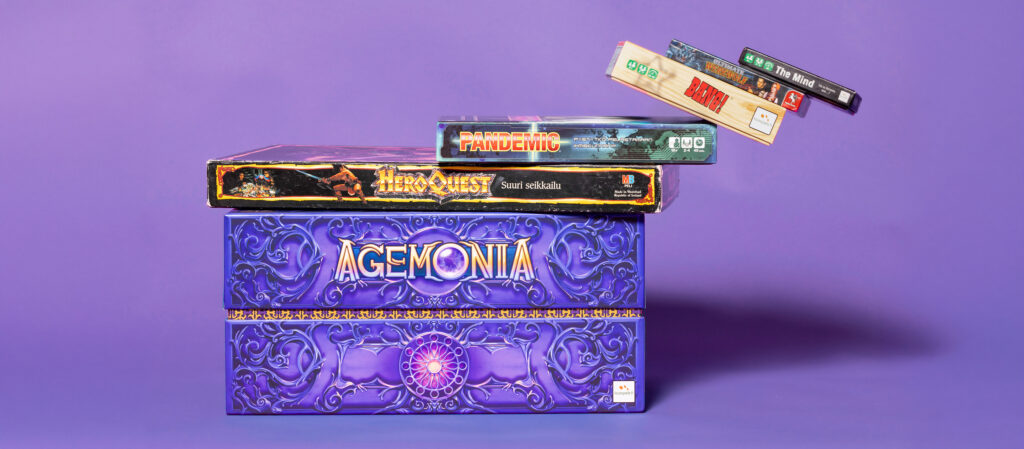
StudioThe Finnish Museum of Games’ miniature exhibition Cooperation is on the table – collaborative board games from Pandemic to Agemonia looks at the world of cooperative board games. These board games pit the players against the board, and the challenges are defeated or lost together. Together with the history of the phenomenon, the exhibition also offers a glimpse into one of the most popular cooperative board games in recent years, the Finnish Agemonia.
-
14.11.2024 – 18.5.2025
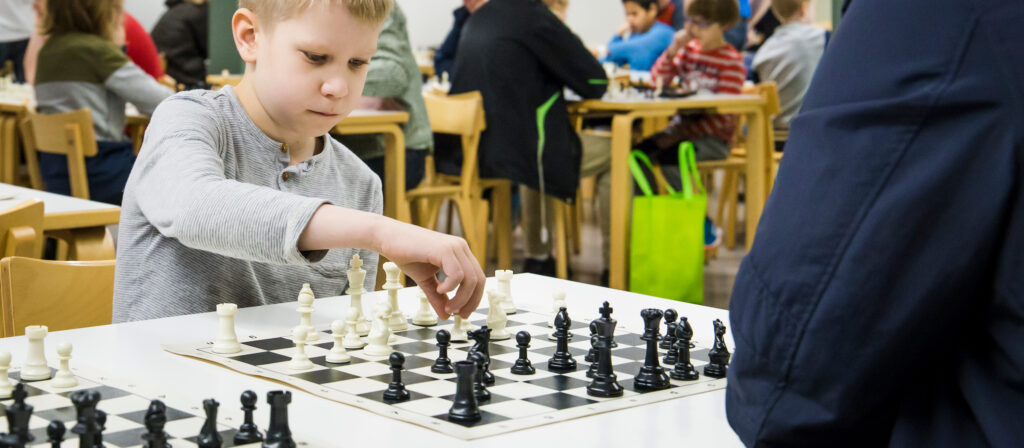
StudioThe Immortal Game – A new age of chess is an exhibition that examines chess as a modern-day phenomenon from three different perspectives: chess as science, a form of art and competition.
The exhibition considers why chess has become such a major phenomenon in recent years. It provides background information in the form of a short overview of the history of chess, and brings out the multiple facets of chess culture. -
8.5.2024 – 26.1.2025
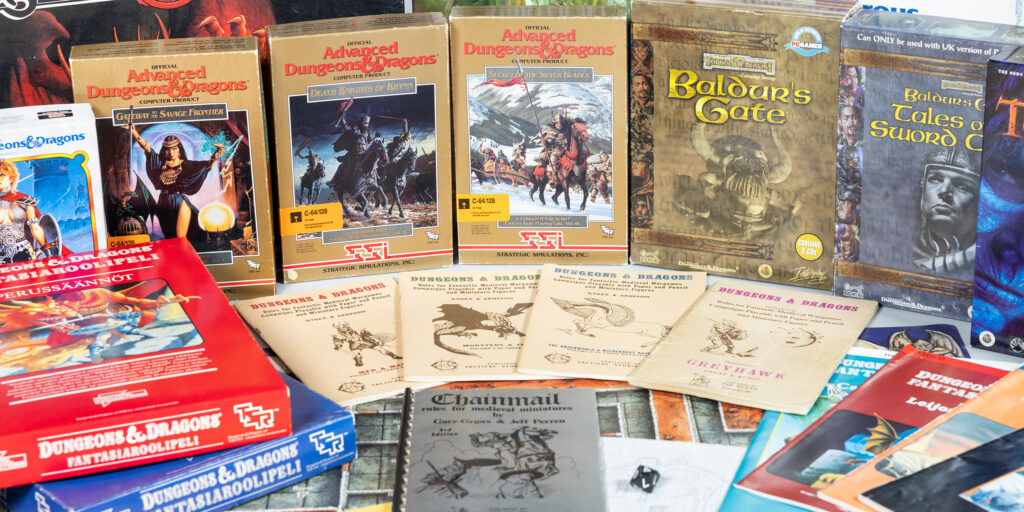
Come and celebrate the dungeons and the dragons – but also the dungeon masters and players – at Vapriikki’s 50 years of Dungeons & Dragons exhibition!
Dungeons & Dragons, the world’s first pen & paper role-playing game, turns 50 years old this year. It is one of the most important phenomena in gaming during the past century – if not the most important one. Dungeons & Dragons has undeniable significance as a phenomenon in gaming and popular culture that has spanned generations, but it has also influenced gaming culture as a whole. Countless modern video games utilise concepts originally introduced in Dungeons & Dragons, such as hit points, levels and character classes – not to mention the monsters and creatures introduced in the game.
-
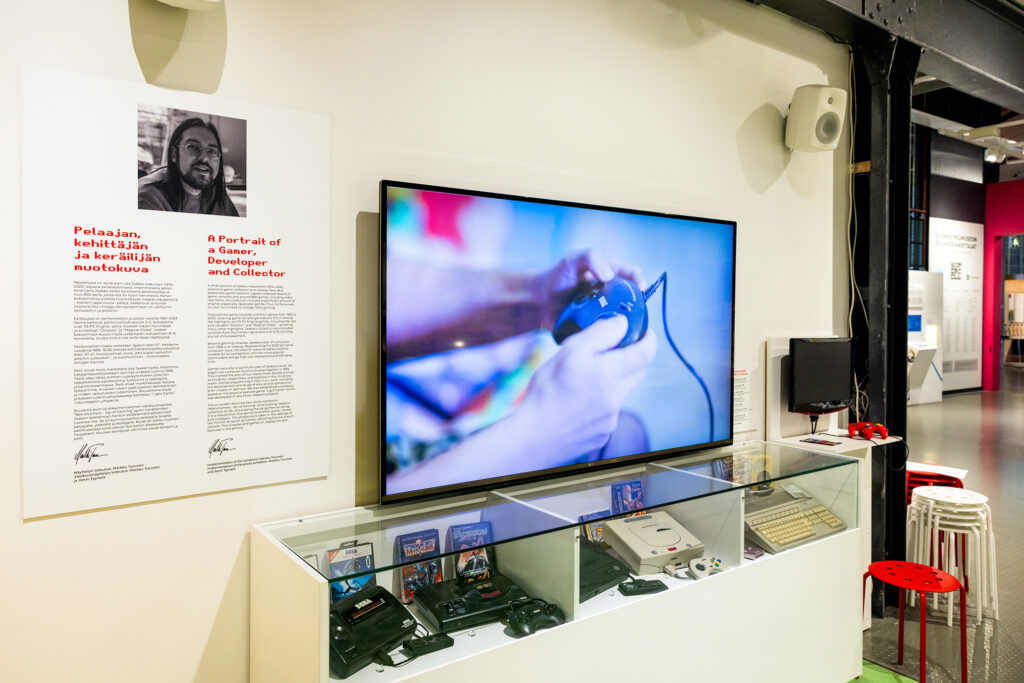
A small portion of Jaakko Hakulinen’s (1974–2022) extensive game collection is on display here. As a passionate game collector, Jaakko collected dozens of game consoles and around 800 games, including many rare items. His collection includes a significant amount of original (especially Japanese) games. Thus, his focus was on, but not limited to, vintage retro gaming.
-
4.5.2024 – 10.11.2024
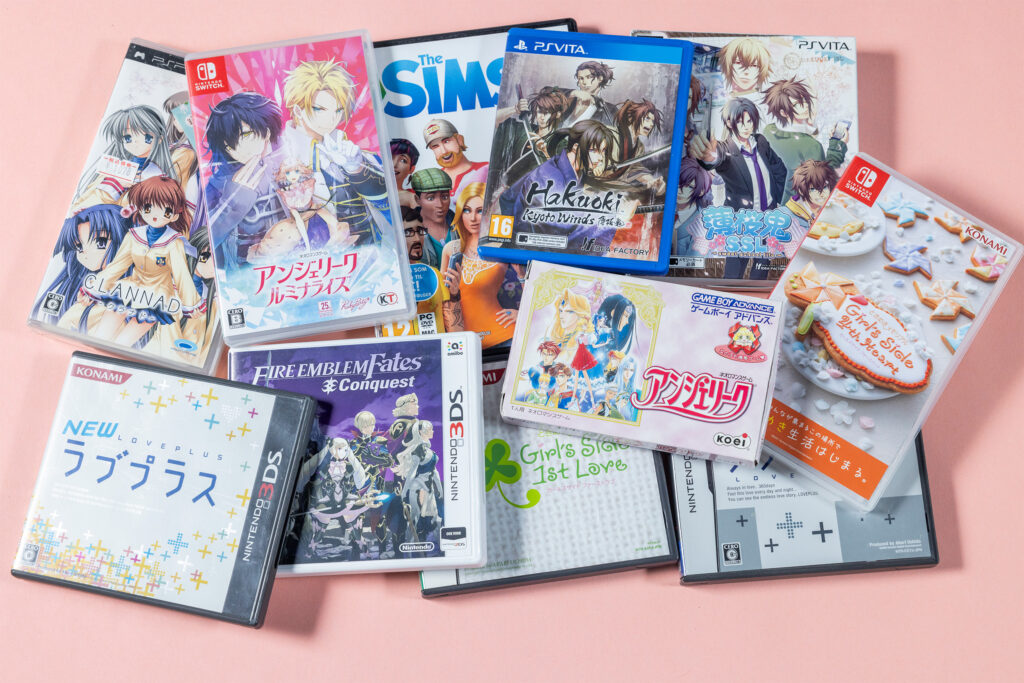
StudioThe Japanese romance games exhibition shows what types of Japanese romance games are out there and their influences on games outside of Japan. Japanese popular culture has grown in popularity at rapid speed since the 1990s. Well known gaming franchises like Mario, Pokémon and Final Fantasy turned Japanese video games into a global phenomenon. As a result, Japanese romance games have also become very popular. They used to only be created for a very niche and small market in Japan, but with the growing globalisation of Japanese video games, many people around the world also play Japanese romance games.
-
4.5.2024
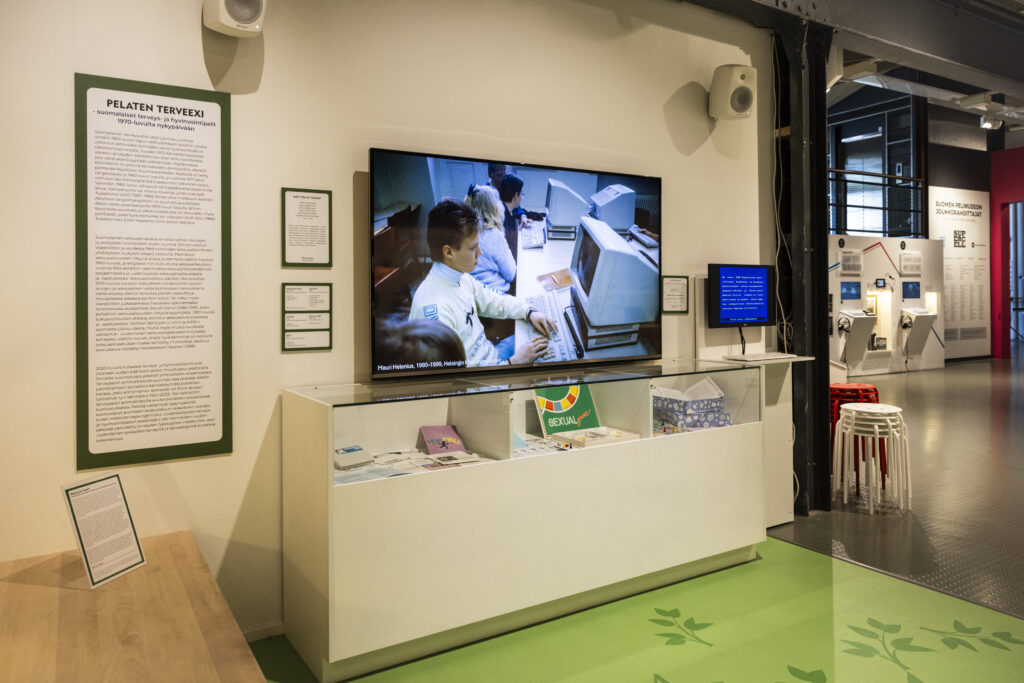
ArenaAn exhibition created by museology students from Tampere University on Finnish educational
games in the fields of health and well-being will open at the Finnish Museum of Games. The exhibition provides insight into how education on health and well-being has been provided through games in Finland over the decades. Interesting games from the late 1980s up to the present day are on display, including both computer games and board games. The games on display have been created to educate citizens on the detrimental impacts of intoxicants as well as on sexual health and social well-being. In addition to the objects, interesting images and texts are used to explain the topic. The exhibition explains to the visitor in an entertaining way about the types of games created at different times as well as how the games and their themes have changed over the years, along with changes in society. -
8.12.2023 – 28.4.2024
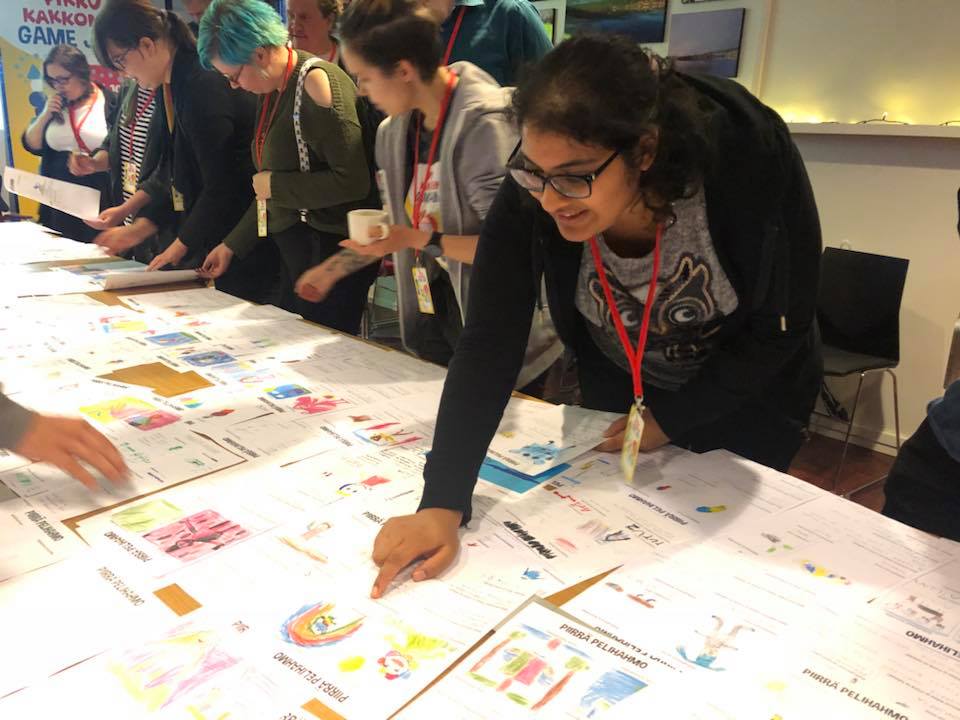
In the exhibition Game Jam stories we dive into the colorful world of game jams in Finland. Game jams bring together a group of individuals interested in game development to create playable games in a short period, drawing inspiration from various constraints. Anyone can participate in game jams, and teams can include both first-timers and individuals who have been making games for decades. There are many jams, and even more stories!
Finland’s first game jam took place in January 2010, when participants in Helsinki, Tampere, Kajaani, and Turku joined the Global Game Jams. In June 2013, the Finnish Game Jam association was formed to guide the game jam craze within this community. The journey has included various game jams. Games have been created on buses, Ferris wheels, tandem bicycles, in the wilderness of Lapland, cottages, libraries, schools, TV studios, planetariums, festivals, conferences, sometimes while sauna bathing, swimming, or soaking in hot tubs, and even in ordinary homes through remote connections.
-

8.12.2023 – 21.4.2024
Over the Barriers: Game accessibility exhibition offers an opportunity to familiarise oneself with game accessibility, understand who benefits from accessibility, gain knowledge of gaming experiences of players with disabilities, and experiment with different game accessibility equipment.
-

19.4.–3.12.2023
StudioThe Moomin books have given joy to readers of all ages and from one generation to another. The timeless nature, playfulness and entertaining, philosophical wisdom of the world created by the artist Tove Jansson (1914–2001) have turned the Moomins into a worldwide phenomenon. The stories deal with lighter as well as more serious themes, such as the roles of children and adults, freedom, responsibility and finding your place in the community.
Jansson, a Swedish-speaking Finn, is one of Finland’s best-known artists as a painter, cartoonist, caricaturist and writer. She also had a knack for business. The first Moomin products were created shortly after the first books and cartoons had come out. The Moomins were later adapted to various media, such as the 1990s animation series and computer games.
This exhibition will introduce visitors to Moomin-themed games made over the decades, ranging from the Moomin board game originally published in the 1950s to modern mobile games.
Visitors may remember some of the Moomin games in the exhibition from their own childhood, as Moomins have been a visible part of Finnish children’s culture for decades already. Some lesser-known games and counterculture that was born alongside the official licensed products are also on display.
-

21.2. — 12.11.2023
How did game controllers become what they are today?
How was the Atari connector created and why was it used almost exclusively in home computers throughout the 1980s? Exactly how wild were the design visions for controllers back in the day?
The Joy of Sticks is based on a private collection of game controllers which collector Mikko Heinonen has acquired from flea markets and online auctions. He has always been fascinated with game controllers from the 1980s that were built by various factories around the world and sold under various names – even though they most often had an identical basic structure.
The key means of differentiation were design and the placement of the fire buttons, for example. At times, we had controllers that can best be described as incomprehensible in terms of ergonomics, but some models achieved nearly mythical status among hobbyists.
-

21.9.2022 — 15.1.2023
The demoscene is a computer hobbyist subculture born in the 1980s that focuses on creating impressive visual demonstrations, or “demos” for short, using programming, music and graphics.
In Finland, the demoscene was born around the Commodore 64 computer, from where it later spread onto other platforms. Finland and the Nordic countries are the birthplaces of the demoscene. Many families bought their first home computers in the mid-1980s. The Commodore 64 was released in 1982 and quickly became massively popular. In Finland, where it sold the most units per capita in the world, it was labelled the “National Computer”.
The popularity of the Commodore 64 made it the most important platform of the demoscene’s early years. Throughout the 2000s, positive childhood experiences with this versatile computer have been bringing many authors back to the platform.
The Pixeled Years exhibition is a comprehensive overview of pixel graphics from the Finnish Commodore 64 demoscene, from the 1980s to the present day. The exhibition was created in cooperation between the Finnish Museum of Games and Zooparty ry. It has been curated by Ari “Duce” Seppä and Tommi “Electric” Musturi.
Image by Ari “Duce” Seppä
-

9.6. – 18.9.2022
Maps can be used to visualise far away, unknown areas. However, not all maps deal with the real world – they can also be made of imaginary places. Imaginary geography is an exhibition on maps made for Finnish games. They are all imaginary in one way or another, as a map can take its viewer on an armchair trip to a multitude of locations – the nearby orienteering grounds or an entirely imaginary world.
The exhibition displays maps used in games over a period of 150 years. Historically, it has been a common practice to use a map of Finland of a specific locality as the basis for the game board. On the other hand, the game map may describe an entirely imaginary landscape or a locality that simply feels real enough to exist in real life. Furthermore, it is not only the game designers who draw maps – the players are also avid cartographers.
Which imaginary world did you last visit through a map?
-

7.5. – 5.6.2022
160 by 144px, 5760 bytes
Nine artists, nine Game Boys
What are the limits of memory?For an entire generation of children growing up in the 90s, the Game Boy was their very own ‘personal computer’. It was not just another piece of hardware, but their first private screen on which adventures could be had, often without the interference of parents. On the schoolyard with friends, or under a blanket with a flashlight, worlds could be discovered on its small and dim 4-colour display. All you needed was a bit of imagination to bring these pixelated realms to life.
Playing is never a one-directional act of consumption. A good game impresses itself on the mind of the player. It is taken in and transformed, and it tickles the imagination of the one playing it. The magic of the Game Boy inspired children to fill in the gaps that games did not want to express, to dream up their own worlds and to express their own ideas. For some, these experiences sparked a career in art.
Memory Limits brings this full circle. For each of our nine artists, the Game Boy becomes the medium for their individual ideas, stories and visions. They have created artworks, one pixel at a time, that are running as software on the original, old hardware. The Game Boy may or may not be part of each artist’s history, but through its plastic lens it becomes our window into their memories.
-

10.2. – 1.5.2022
The exhibition deals with changes in game journalism from the 1980s to this day. Based on the memories and stories of game journalists, the exhibition focuses on the golden age of Finnish game magazines, especially MikroBitti and Pelit. Game journalist legends Tuija Lindén, Niko Nirvi, Kaj “Kaitsu” Laaksonen and Jukka O. Kauppinen share their stories, and the exhibition features all kinds of rarities and curios from their collections.
-

4.9. – 12.12.2021
Noita is a Finnish dungeon adventure full of secrets, where the player wanders in a ruthless pixel world, harnessing the forces of nature to further their goals. The Noita – The Long Journey of a Game Idea exhibition details the games development from preliminary first ideas and through various phases all the way towards a finished form.
The game’s idea may change several times during the development process, and it may be difficult to grasp all the factors that contributed to it in retrospect. The functionality of the game is tested using different prototypes, and the game idea’s central features may change a lot between them. On the other hand, the game’s production team will not have the ability or time to implement every idea they can think of.
The development process behind Noita has been surveyed to an exceptional extent. The pre-history of the game goes back dozens of years, starting from the games that have inspired the developers and leading up to the first experiments in game-making. The exhibition gives you an idea of the long journey of Noita’s development, but the best way to understand the game is to play it and get involved in the player community. Noita is full of secrets, and discovering them is at the core of the gameplay experience. What is Noita really about? Have all the secrets been revealed?
-

8.9.2020 – 4.1.2021
Board games have been published in Finland for nearly 160 years. While Afrikan tähti, Kimble and Alias are familiar to most Finns, very little attention has been paid to the early steps of board gaming in our country. The Old Board Game Treasures exhibition turns the spotlight on six nearly forgotten games from the dawn of board game history.
-

9.6.2020 – 23.8.2020
A retrospective in the Finnish Museum of Games’ studio shows, for the first time, an extensive collection of photographs by Tuomas Puikkonen. The exhibition is curated by the photographic artist and LARP designer Katri Lassila (MFA).
Photographer Tuomas Puikkonen started to photograph LARPs in 2010. Puikkonen was working at a university, but had been involved in the role-playing and photography hobbies for years. He joined a LARP series workgroup with the intention to make the experience even more fun for the players and, to this aim, chose to work with documenting the game.
Over the years, the experiment grew into an entire career. Puikkonen has photographed 70 LARPs over ten years. He has shot fantasy and sci-fi, realism, vampires and serious political LARPs as well as light-hearted fun and art projects.
Over the decades, Tuomas Puikkonen has developed a unique, recognisable style. Puikkonen is primarily interested in the interaction between the characters. Many of his most acclaimed photos represent situations where even the viewer can sense the tension between characters. Puikkonen uses digital equipment and retouches his photos creatively, using tones and contrasts to convey a message about the LARP’s atmosphere, for example. Therefore, a dystopian future might have cold blue tones, whereas a gentle love scene in a romantic game is warm and well-lit.
-

13.12.2019 – 29.3.2020
The Kalevala in Games exhibition showcases intersections between the world of games and the cultural heritage of Kalevala across more than one hundred years.
The Kalevala is living culture that belongs to everyone. Games mix together the source material from Kalevala, mainstream popular culture from their time of publication and different forms of art. Each of the nine games on display has an individual relationship with Kalevala. The exhibition also invites you to consider the relationship of their publication time and target audience with our national epic.
Finnish game designers have been inspired by the Kalevala since 1904. However, no games about the Kalevala were released for 58 years following Kalevala — peli Suomen lapsille (1930), until ANKH, Adventurers of the North — Kalevala Heroes (1988) brought the Kalevala back into the world of games with an entirely new look. In the 1990s and 2000s, role-playing and LARPs became the form of gaming that extensively utilised our national epic. In digital games, Kalevala has only become a hot commodity during the past ten years. You could say that we are now living in the golden age of games about Kalevala, and the entire potential of our national epic has surely not been fully exploited yet.
Kalevala is more than simply source material for games. Finnish game designers have enriched its cultural heritage in refreshing ways, even mixing in surprising elements. In addition to entertaining players, games have used Kalevala as a learning tool, and even to critically examine Kalevala’s contents and thoughts.
-

13.9. – 1.12.2019
In location-based games, the city – its streets, architecture and everyday objects – become the “game board”. They bring the physical environment into the game through mobile and GPS technologies that track their players’ locations. The release of Pokémon GO in 2016 launched location-based games into the mainstream. But these games have a much longer history, dating back to early artistic and commercial experiments from the early 2000s onwards. This exhibition showcases this broader history, from the invention of geocaching to the first experimental games like Can You See Me Now? and Pac-Manhattan, and finally their eventual mainstream success through smartphone apps like Parallel Kingdom, Pokémon GO and, most recently, Harry Potter: Wizards Unite.
-

19.3. – 1.9.2019
The reign of the Commodore 64 started in the spring of 1983. Even before then, home computers had attracted a subculture of BASIC programming enthusiasts. Tips were shared through word of mouth, tapes filled with data were passed from one friend to another and user manuals were studied for guidance in programming. User associations were born around the different home computer brands.
In Tampere, Reima Mäkinen and Petri Tuomola started publishing a magazine called Micropost in January 1983. The editors had Sinclair and Commodore machines on their desks. The association Suomen Mikromaakarit ry was later founded to act as the magazine’s publisher.
Finland’s most popular technology magazines, such as Tekniikan Maailma and Tietokone, mainly wrote about computers for business use. Micropost, on the other hand, was focused on entertainment. Its readers were mostly interested in games and playing with the hardware.
The exhibition uses game demos, drawings, printouts and other documents to look back at a time when writing your own games was easier than buying them in a store.
-

12.10.2018 – 10.3.2019
The Commodore 64 gave birth to a varied and rich subculture of personalised disk covers. Demoscene and cracker groups from around the world used skilfully hand-drawn and photocopied covers to decorate their products from the 1980s onwards.
Floppy disks, or floppies, needed paper protection when, before the age of the Internet, they were sent by mail from one hobbyist to another. Mega swappers could have hundreds of addresses on their mailing lists. In the end, disk covers became an essential part of the C64 culture. The demoscene is very much alive and well on the Commodore 64 and keeps producing new disk covers with its new releases. The Disk Covers exhibition displays these works from a vibrant subculture for the first time ever in Finland.
Disk Covers presents covers from the 1980s up to the present day. Works from Finland and from around the world are on display. The exhibition was curated by Ari “Duce” Seppä and Tommi “Electric” Musturi together with Zooparty ry, an association specialising in C64 culture.
-

30.5.2018 – 7.10.2018
The Quirky Handhelds exhibition showcases game collector Manu Pärssinen’s comprehensive handheld game console collection. Almost 100 handhelds and their quirkiest features from the 70s onwards are exhibited.
-

24.3.2018 – 27.5.2018
Cosplay (from the words costume play) involves dressing up as different characters. Cosplay is often thought to be connected to manga and anime, but cosplayers can choose their characters from all kinds of sources. Cosplaying is, however, much more than just dressing up. The Cosplay – from game to reality exhibition is made up of three costumes, as well as photographs and stories by cosplayers.
The exhibition is produced in co-operation with Lunatar Cosplay and Cosvision ry. Cosvision ry is an association which aims to advance cosplay as a hobby in Finland. The association produces the yearly Finnish Cosplay Championships, does cosplay projects such as individual cosplay competitions and works for cosplay promotion.
Photographer: Timo Virtanen
Cosplayer: Noora Cosplay
Character: Tyrande Whisperwind / Heroes of the Storm -

16.1.2018 – 11.3.2018
WHAT DOES GAMING FEEL LIKE?
Everyone has a game history of their own. All of us spend time with toys, play and games, all the way from youth to adulthood and old age. We play alone but also together with parents, children, relatives, friends and strangers. The My Game History exhibition presents thirteen Finnish personal histories of gaming and play.
-

24.10.2017 – 14.1.2018.
Pelit is one of the oldest continuously appearing game magazines in the world. It is also an integral part of Finnish game culture. The exhibition is realized by Pelit magazine.
Kuva: Pelit-lehti
-

22.8. – 22.10.2017
Masters of Pixel Art is an exhibition curated by Klas Benjaminsson (AKA Prowler), featuring the finest pixel art for both the Commodore 64 and the Amiga
-

23.5.2017 – 13.8.2017
Ropecon is the largest volunteer-organized role-playing game convention in Europe, bringing together both hobbyists and professionals. The Ropecon exhibition is realized in co-operation by Ropecon ry, The Finnish Museum of Games and Espoo City Museum.
-

21.3.2017 – 21.5.2017
P.O.L.L.E.N is a science fiction adventure game made by MINDFIELD GAMES. It was published in 2016. In the game, the player tries to understand what has happened on an abandoned space station. The game is viewed from the player character’s perspective (first-person). The production of the game lasted over two years and the game went through many drastic changes during the development.
This exhibition displays the evolution of P.O.L.L.E.N throughout its development. It includes screenshots and design documents of the different versions of the game. Over 300 pages of backstory and designs were written for the game, in addition to hundreds of graphic objects and gameplay functionalities. Some of these designs never progressed from the pencil and paper, while some were made ready but for some reason or another were dropped from the final game. As a result of this process of collecting and discarding features, we have a unique game with a versatile and functional environment; one can spend hours exploring. Experiencing the world using virtual reality devices offers a highly immersive atmosphere.